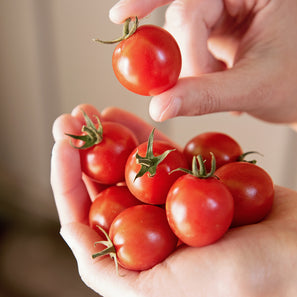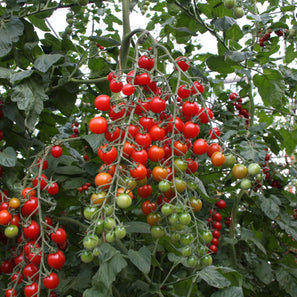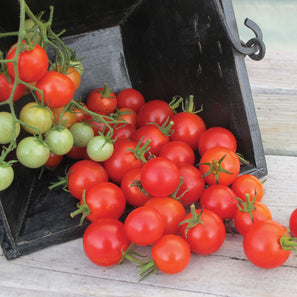
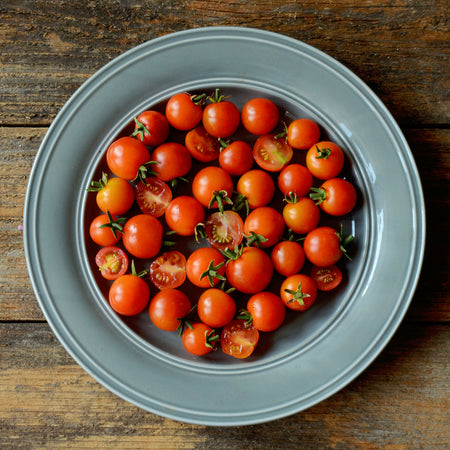
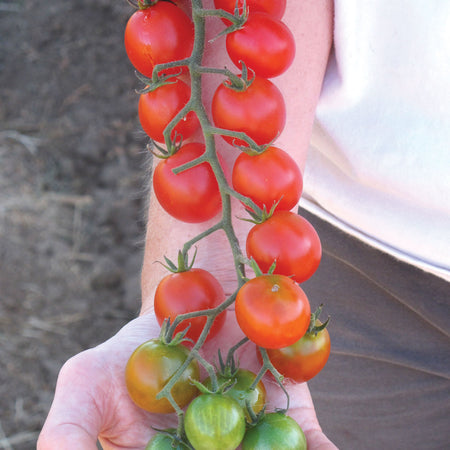
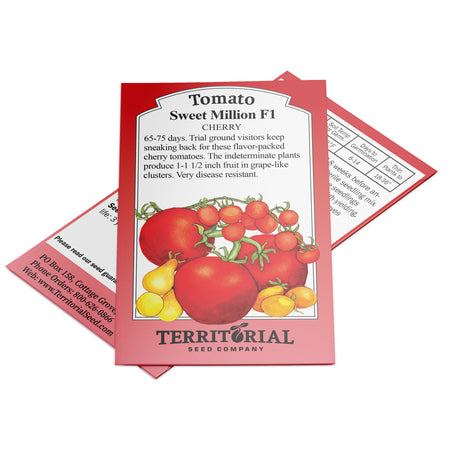


SWEET MILLION
Product Description:
-
Key Features:
-


-
Key Features:
-
| Soil Temp for Germ | 70-90°F |
| Seed Depth | 1/4" |
| Days to Emergence | 6-14 |
| Soil Temp for Transp | 55°F |
| Plant Spacing | See below |
| Row Spacing | 3-4' |
| Fertilizer Needs | High |
| Minimum Germination | 80% |
| Seeds per Gram | ≈ 280-320 |
| Seed Life | 3 years |
Lycopersicon lycopersicum The first ripe, juicy tomato of summer is a delicious milestone of the season for gardeners. Each year we test and evaluate more than 250 tomato varieties to bring you the most flavorful, best performing selections, for every desired use. An array of nutrients and antioxidants including the especially potent lycopene, found in its highest concentration in tomatoes, supports healthy eyesight, cardiovascular health, cancer-fighting capacity, and more.
Days to maturity are calculated from date of transplant.
Culture
• Determinate tomatoes: grow compactly, sprawling laterally, usually do not require staking, and fruit ripens over a short period of time
• Indeterminate tomatoes: grow on long vines, generally require pruning to 1 or 2 leaders that need to be trellised
• Fertile, well-drained raised beds covered with plastic mulch promote early growth and better yields
• Tomatoes are high feeders and will benefit from regular fertilization with Age Old Bloom
• To prevent blossom end rot use a high calcium amendment
• Overwatering can cause fruit to crack
Direct Sowing
• Not recommended
Transplanting
• Sow seeds in trays 6-8 weeks before anticipated transplant date; up-pot into 3-4 inch pots when the first set of true leaves appears
• Strong light and cooler temperatures (60-70°F) prevent plants from getting leggy
• Fertilize with Age Old Grow every 10-14 days
• When transplanting work in compost, 1/2 cup of TSC's Complete fertilizer, and handful of bone meal
• Determinates can be spaced 18-24 inches apart, indeterminates 24-36 inches apart
• Tomatoes can be buried up to the top 2 sets of leaves
• Use Kozy-Coats or Victorian Bell Cloches to protect young plants
Insects & Diseases
• Common insects: Flea beetles and tomato hornworms
• Insect control: Pyrethrin or row cover for flea beetles, and Monterey B.t. for tomato hornworms
• Common diseases: Early and late blight
• Disease prevention: A strict 3-4 year rotation, remove vines at the end of the year, fungicide
Harvest & Storage
• Harvest when fully ripe, do not refrigerate for best flavor
• Green fruit should be ripened in a cool, dark area; make sure fruit are not touching
KEY TO TOMATO DISEASE RESISTANCE AND TOLERANCE
• HR indicates high resistance.
• IR indicates intermediate resistance.
• Aal | Alternaria Stem Canker
• AB | Early (Alternaria) Blight
• B | Bacterial Wilt
• F* | Fusarium Wilt
• FOR | Fusarium Crown and Root Rot
• L | Gray Leaf Spot
• LB* | Late Blight
• LM* | Leaf Mold
• N | Roundworm | Nematode
• Pf* | Leaf Mold | Passalora fulva
• PL | Corky Root Rot
• PST* | Bacterial Speck
• RK | Root-Knot
• TMV | Tobacco Mosaic Virus
• ToANV* | Tomato Apex Necrotic Virus
• ToMV* | Tomato Mosaic Virus
• TSWV | Tomato Spotted Wilt Virus
• TYLCV | Tomato Yellow Leaf Curl Virus
• V* | Verticillium Wilt
* Numbers and letters indicate specific disease race.